

Three weeks of working is not the same as ready
Three weeks of working is not the same as ready.
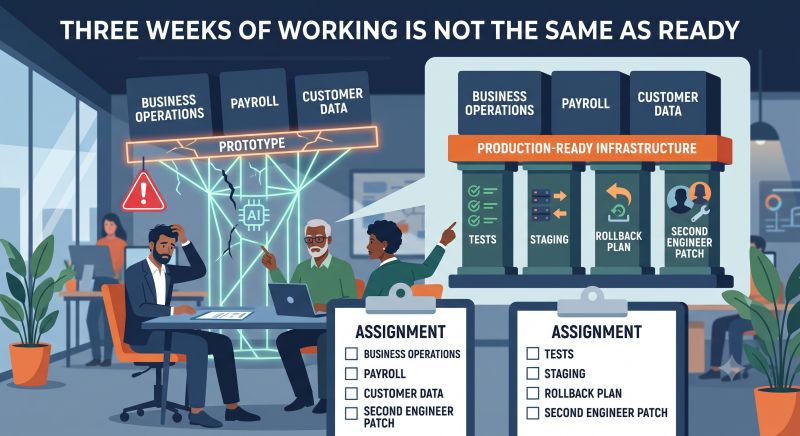
Yesterday, I sat on a call with a small business owner and a senior engineer. The owner had spent months building his own operations software with AI as the second pair of hands. It worked and it was live, processing real transactions. A hundred people were about to start using it.
Forty minutes in, the engineer asked the question: "If the system went down today, how long could the business survive without it?"
The owner looked at the engineer, then at me, and the room went quiet for a second longer than it should have: "Maybe three weeks", he wasn't sure.
That is the gap almost every operator building with AI is about to discover. The distance between "the software works" and "the business can run on it."
His system had no tests, no staging environment, no rollback plan. No one but him who understood it. When a bug surfaced, he shipped the fix straight to the live system, because that was the only system that existed.
None of this was negligence, it is the natural shape of a prototype that quietly became infrastructure while nobody made the decision to promote it. A prototype that doesn't work gets thrown away. A prototype that works gets used, then depended on, then load-bearing.
AI didn't create this, it just made the speed of it dramatic. What used to take a team three months you can now ship in a week. The week to build is the easy week. The work to make it production ready is the work nobody quoted you for.
Here is your assignment:
- list every internal system your business runs on, including the AI-built ones from the last six months.
- for each, write one sentence: "If this died tonight, for how long will we survive?" Then take the one with the shortest answer and check four things: tests, staging, rollback, a second person who can patch it.
Wherever the answer is no, that is your next month of work. Ask it on a calm Tuesday, not a Thursday after something went down.