

Who is your Julia?
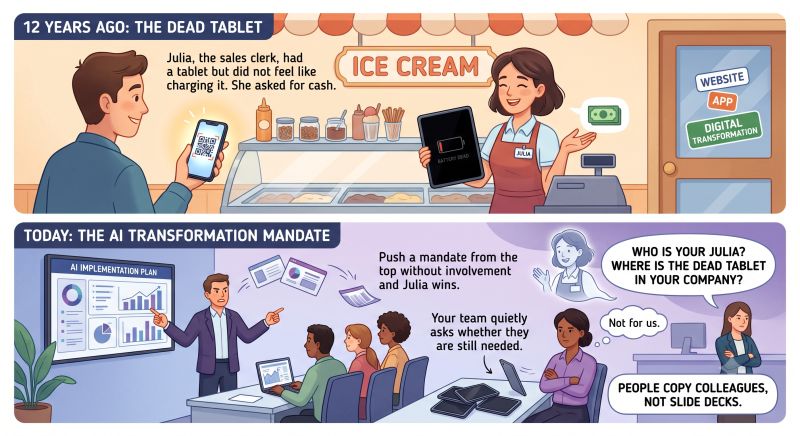
Twelve years ago my former co-founder and I tried to pay for ice cream with a QR app that was supposed to be the future. The technology worked. Julia, the sales person, had a tablet for exactly this purpose. But the battery was dead, she did not feel like charging it, and she asked us for cash.
I still see Julia in every company that buys new technology and wonders why nothing changes.
The sticker on the door keeps changing: website, then app, then "digital transformation," now "AI transformation." The person who has to use the thing every day keeps finding a reason not to.
This is not a rare failure. In October 2024 BCG surveyed 1,000 executives across 59 countries and found that 74% of companies had yet to show tangible value from AI. The same study found that only about 10% of the obstacles were the technology itself. Around 70% were people and process. The machine is almost never what fails. Julia is.
Most transformations never actually happened for one reason: buying software is easy, and changing how people work is hard.
AI makes this worse. The resistance is no longer about a harder workflow. It is about identity. People quietly ask whether they are still needed, and they say "not for us" or "maybe next quarter" instead of refusing out loud.
So when I work with Business Owners on this, I ask three questions before we ever talk about platforms:
- Who on your team already wants to try this?
- Can they show the person at the next desk before you announce a mandate?
- Did your team help build the thing you are asking them to use?
People copy colleagues, not slide decks. Push a mandate from the top without that involvement, and Julia wins every time.
QR payments were ready twelve years ago. Julia was not. With AI the pattern is exactly the same, and now the numbers prove it.
Who is your Julia? Where is the dead tablet in your company?